
Finding Plainview Resident Records
Plainview is the Hale County seat, so a useful residents directory route often crosses city, county, and state custodians. Hale CAD is the best current property starting point. It ties an owner of record to a parcel, a situs address, and a legal description. Texas My Voter is a separate person-focused check, while the Hale County Clerk holds recorded-document, probate, vital, assumed-name, and records-search functions. Each source describes a relationship, not a complete household. A property owner can live elsewhere, and a voter match is not an open street list.
Use the detail already known. A current street address usually starts with CAD. A full name plus a county, date of birth, and ZIP can fit the VoteTexas route. An older name or address belongs at Unger Memorial Library, where printed directories, newspapers, census microfilm, and yearbooks add dated context. If an official web screen does not cover the needed record, the next route is the counter, telephone, mail procedure, or a written Texas Public Information Act request for an existing non-exempt record.
- Search the Hale CAD property card by owner, address, property ID, or legal description.
- Compare the situs address with the mailing address before treating either as residence evidence.
- Use VoteTexas for a person-oriented registration match with the required identifying fields.
- Ask the County Clerk or District Clerk about a specific instrument, probate matter, or court file.
- For an earlier household, take a street and date to Unger’s local-history desk.
Plainview Resident Records Offices
Three offices form the core local records map. The Hale County Clerk is the recording and vital-record contact, not the District Clerk. Hale CAD maintains appraisal and parcel records. Texas voter administration uses a statewide lookup with Hale County selected by the searcher. Those offices answer different questions, and their records should not be blended into a claim that a person lives at a particular address. The address-by-address work belongs on the Plainview street directory route, where parcel, GIS, deed, and city-file steps are kept separate.
Texas Elections Lookup
Statewide service for Hale County
Use name, county, date of birth, and ZIP
County records contact: (806) 291-5261
District-court files are held through the District Clerk at 225 Broadway, Suite 4, Plainview, with a separate official civil and criminal public-access endpoint. The research inspection could not open that portal’s form, so its local fields and coverage are not assumed here. A specific party, case-number, or copy request to the clerk is the documented fallback.
Plainview CAD Records Search
The public Hale CAD Property Search accepts owner, street, property ID, geographic ID, legal-description, subdivision, neighborhood, and tax-year paths. The portal tells searchers to use a street name without prefix, suffix, or unit, and to try name variants when a full owner entry fails. Public cards are useful locators. They are not certified title evidence, and the separate taxpayer portal requires an owner ID and e-file PIN rather than offering another public resident search.
One inspected card illustrates why address meaning matters. It shows a Plainview situs and an Austin mailing address. The situs identifies the parcel on the ground; mailing is correspondence for the owner or agent. A legal description and geographic ID are more stable when spelling or numbering differs. The card’s deed-history rows are an aid to instrument research, while certified document images remain a County Clerk question.
| Hale CAD field | Search use | Local caution |
|---|---|---|
| Owner Name | Last name first, or a partial variant | An owner is not necessarily an occupant. |
| Street Number and Street Name | Locate a parcel by situs | Use the portal’s street-name formatting guidance. |
| Property or Geographic ID | Bridge GIS, card, and deed research | Keep the selected tax year with the result. |
| Legal description | Match a deed, plat, lot, or subdivision | It can outlast a changed street string. |
| Neighborhood and Tax Year | Narrow nearby or dated property results | District-wide historic coverage start is not stated. |
Note: CAD cards describe appraisal and parcel relationships, so a current address needs confirmation from an independent, dated source.
Plainview Voter Lookup Limits
VoteTexas My Voter is a registration and polling-place tool, not a public household directory. Its documented form asks for name, county, date of birth, and ZIP. That makes it a useful match after a name has a Hale County anchor. It does not provide a general street browse, and the research did not capture a live personal result. Texas does not register voters by party, so party participation should not be inferred from this lookup.
Texas Election Code rules divide public and confidential voter information. Social Security numbers, driver-license or DPS ID, phone information, and protected addresses are not ordinary public-directory fields. Address Confidentiality Program participants and certain qualifying people have additional safeguards. A full voter file is a different process: the Secretary of State form calls for a notarized affidavit, a $75 deposit, restricted use, and a statutory release process. It is not a substitute for patient, lawful name verification.
The captured My Voter form below shows the individual match inputs, not a Plainview household or block result.
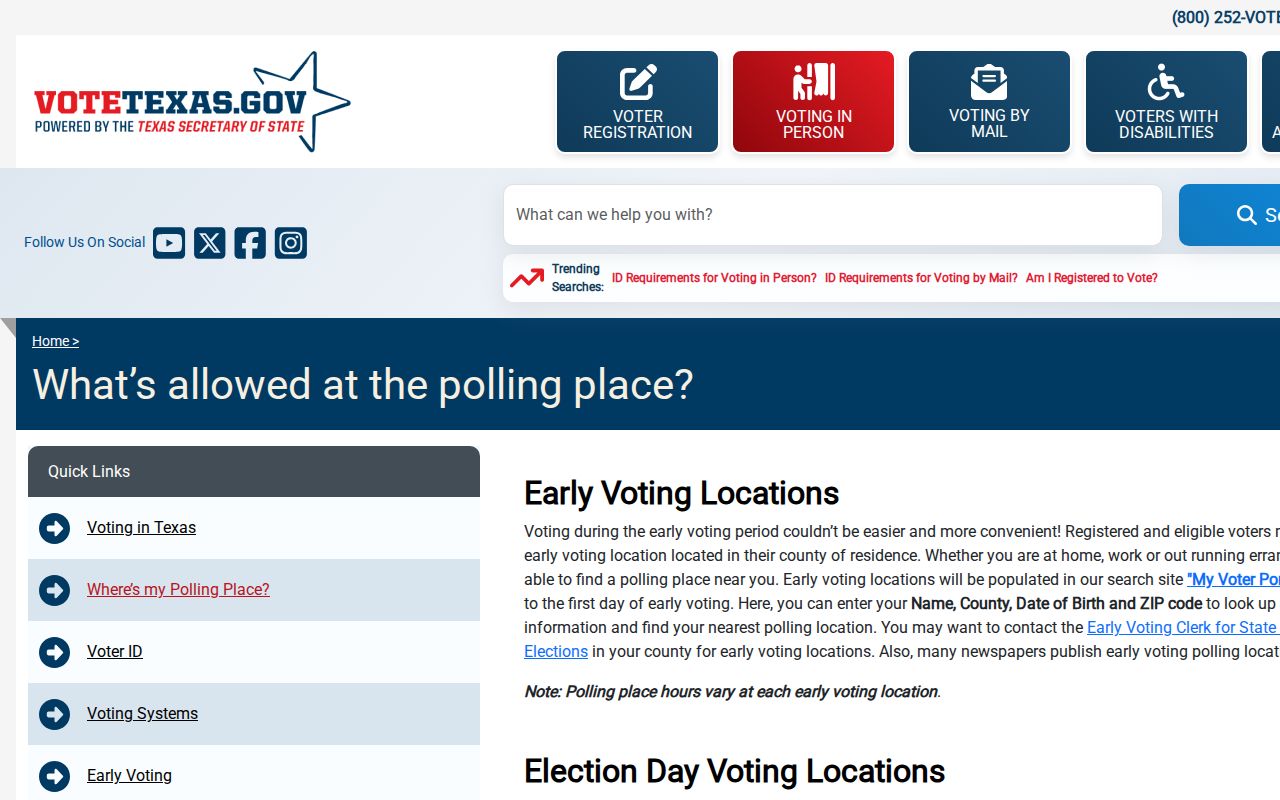
The form supports a carefully limited registration check after a name has sufficient lawful context. It does not expose protected records.
Plainview Court and Vital Records
For a person named in a local court matter, the official Hale County Civil and Criminal Public Access endpoint is a starting URL, but it returned a 403 during the research inspection. The result fields, coverage dates, and images were therefore not verified. The District Clerk is the fallback for a focused party, case-number, docket, or copy request. The statewide Texas appellate search is public and refreshes nightly, but it is not a replacement for local trial files.
Vital records have their own custody and access rules. The County Clerk offers qualifying local birth, marriage, and death ordering through its Permitium service. Hale births are stated as available back to 1928 and Hale deaths back to 1930. Texas Government Code §552.115 opens birth records after 75 years and death records after 25 years, while recent certified copies are limited by eligibility. Texas DSHS forms and ordering routes serve statewide events; a verification is not the same as a certified certificate or a current-residence record.
When access fails, preserve the case details already known and ask the District Clerk where a releasable file is held. A portal landing page does not establish that a local court has a result for a particular Plainview resident.
Plainview Current Resident Sources
Current records work best when the question matches the keeper. Hale CAD has current property relationships and parcel facts. VoteTexas has a person-oriented registration check. The County Clerk can route a deed, probate, assumed-name, or vital request. City Community Development can be asked for a particular permit or certificate-of-occupancy file, but no public online permit search was located. These records are narrower than the everyday meaning of a residents directory, yet they have documented custodians and dates.
| Plainview source | Relationship it can show | Custodian | Access route |
|---|---|---|---|
| CAD property card | Owner, situs, mailing address, parcel, value history | Hale CAD | Public property search |
| Voter lookup | Registration/polling match | Texas SOS | Name, county, DOB, ZIP form |
| Recorded document | Grantor, grantee, legal description, instrument trail | Hale County Clerk | Counter, request, or copy inquiry |
| Permit or CO file | Address, project, owner/applicant, work evidence | City Community Development | Specific file request |
| Professional license | Public status and permitted profile fields | Texas licensing boards | State board lookup |
For one-person verification, the Plainview resident lookup route pairs records rather than treating any one result as proof. A name on a deed, case, or license usually proves only the record relationship stated by that source.
Plainview License and Name Trails
Texas state sources can add a public status check when a name is tied to a regulated service or a business. The Department of Licensing and Regulation Verify a License entry point and specialized boards use their own fields and disclosure rules. SOSDirect is the state entity portal for business name, registered agent, filing history, and copies. Hale County Clerk records also include assumed names. A business address or registered agent is an affiliation lead, not evidence that an individual resides there.
The TDLR search example below shows why a search should be limited to the question at hand. Its captured controls include registration type or number, a name, expiration, city, county, and ZIP. Public fields vary by board, and some personal contact information remains confidential under Texas law. The screenshot is a state search interface, not a roster of Plainview people.
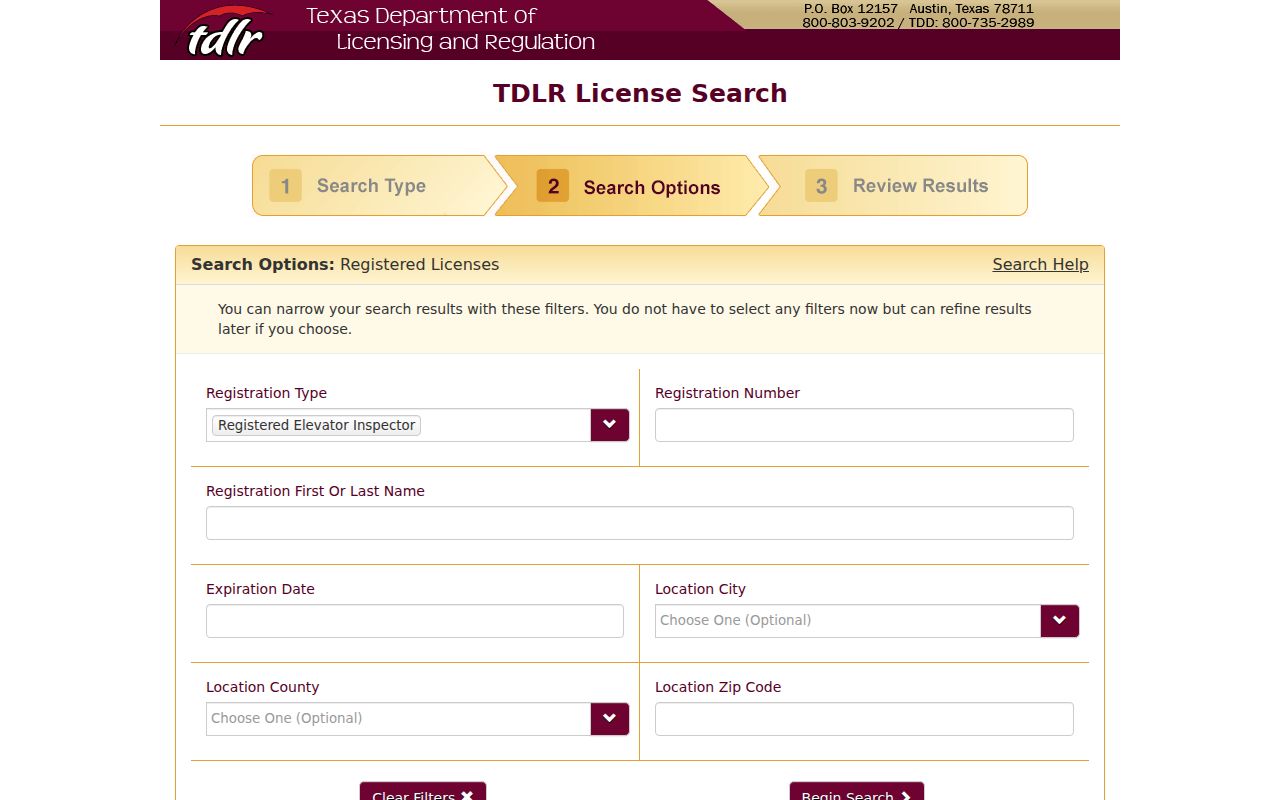
Use an official board profile to check a license status or filing relationship, then preserve its date and identifier. Do not turn a professional or entity listing into a household claim.
Plainview Records Request Paths
Some useful Plainview records are not online at all. Building permits, municipal case details, police report copies, directory entries, criss-cross listings, and older deed materials have documented counter or request paths. The Texas Public Information Act, Government Code chapter 552, covers requests for existing public records unless an exception applies. Ask for a record description, date range, address, instrument number, report number, or case number. A government body does not have to create an answer or conduct a new research project.
The city’s Plainview Open Records Request route accepts email at ORR@plainviewtx.org or mail to the City Secretary at 202 W 5th St. Keep a copy and proof of delivery. The city screen captured below is the documented route for records the city holds. County Clerk, District Clerk, library, and state offices each have their own counter, phone, form, or mail channel when they are the custodian.
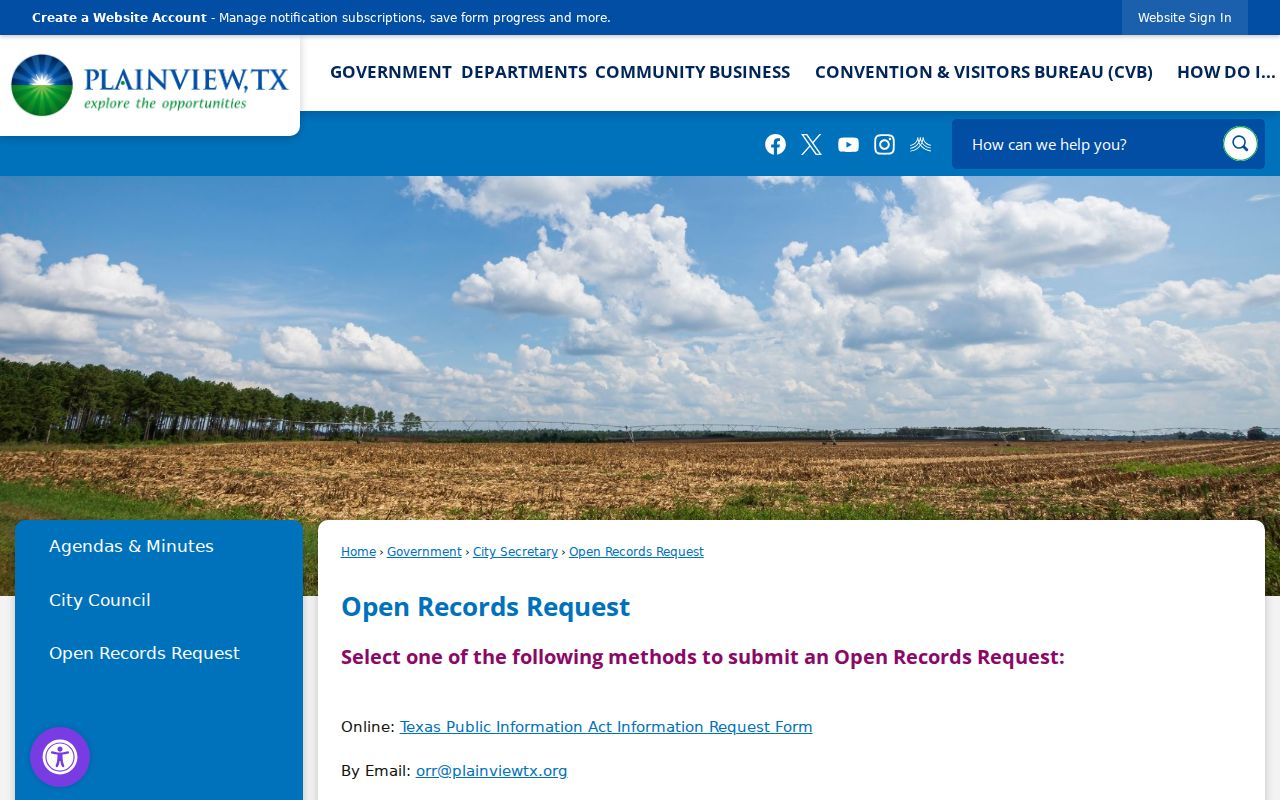
The city request route helps when a form exists online but the underlying permit, code, or public-document file has no searchable index.
Plainview ZIP and Parcel Geography
Plainview’s confirmed postal labels are 79072 and 79073. They are useful filters, but they are not verified city-limit polygons. A Plainview mailing label alone does not prove that a parcel sits inside the incorporated city, because Hale County’s geography is much wider. The reliable local check combines the CAD situs, legal description, city GIS or zoning context, and taxing jurisdictions. The zoning map shows numbered east-west streets and named north-south streets such as Broadway and Austin, with quadrant notation in city address materials.
The USPS ZIP Code Lookup has address, city/state, and cities-by-ZIP modes. It can confirm a postal format, not establish ownership, all occupants, annexation, or a city boundary. CAD uses parcel identifiers and tax years instead of a captured public ZIP filter. The ZIP route remains useful for narrowing a search before an address moves to a parcel or historical record.
- Parcel
- A defined piece of land represented by a CAD or GIS identifier.
- Situs address
- The physical property location used by appraisal and city records.
- Legal description
- The lot, block, subdivision, or other land description used in recorded documents.
- Criss-cross directory
- A historical address-to-name arrangement that must be checked in person at Unger.
Plainview Resident Privacy Stops
A public record has boundaries. Recent vital certificates, DMV data, utility accounts, protected voter addresses, sealed or juvenile files, and ordinary non-owner household members are not an open residents directory. Texas Address Confidentiality Program participants and qualifying protected voters require special handling. A court or property record can name a person without showing a current address. A map or street result should never be used to infer who belongs to every home on a block.
Official records and commercial compilation services answer different questions. The comparison is practical: official records show a stated relationship, custodian, and date; commercial compilations may combine stale or mismatched data. Return to the Hale CAD card, clerk file, DSHS process, court clerk, library original, or state portal before relying on a name match.
| Official record route | Commercial compilation category | Best practice |
|---|---|---|
| Shows a custodian, record type, and date | May merge historical and marketing data | Verify every important match with the custodian. |
| Has statutory privacy limits | Can retain stale or incomplete entries | Do not attempt to reconstruct protected information. |
| May require a counter or request | May charge for convenience | Use the official path for an authoritative record. |
Note: Texas Penal Code §42.072 addresses stalking, and records research must never be used to harass, threaten, or harm anyone.
Plainview Historical Directory Trails
Unger Memorial Library is the local historical anchor for Plainview residents directory research. Its local-history information confirms city and telephone directory back issues, criss-cross materials, census microfilm, newspapers, and Plain View yearbooks back to 1914. The library does not publish a complete verified city-directory run online, and staff will not provide city-directory or criss-cross results by phone. Take a name, street, and approximate year to the front desk instead.
Plainview Daily Herald microfilm reaches back to 1908 at Unger. Texas Tech’s Southwest Collection lists complementary Daily Herald and Evening Herald reels, some stored in a cold vault that should be requested in advance. Historic address work can pair a directory year with census microfilm, a newspaper date, a deed legal description, and the 1910 or 1914 Sanborn map. The full collection method belongs with the historical city-directory material, while each source still needs its own date and context.
Plainview Library Record History
Plainview’s record trail reflects the town’s 1887 post office, 1888 county-seat organization, 1889 local newspaper, and 1906 to 1907 railroad era. Those dates help choose the right shelf or reel without claiming that any one series is complete. Library materials provide the continuity that an online CAD card or blocked court portal cannot. The local newspaper, census cabinet, yearbooks, historical quarterlies, directories, and Sanborn maps each answer a different dated question.
Unger was re-accredited for 2026, with TexShare access and remote licensed-database access for active cardholders described in local reports. That expands the research route but does not make all local directories searchable from home. Start with the catalog or library desk, verify present services before travel, and use microfilm, reader, printer, or staff referral where the item is shelf-only.
The Hale CAD property-search screen below is the current-record counterpart to that library trail. It is a public locator with address and owner fields, while the library supplies the historical context a property card cannot provide.
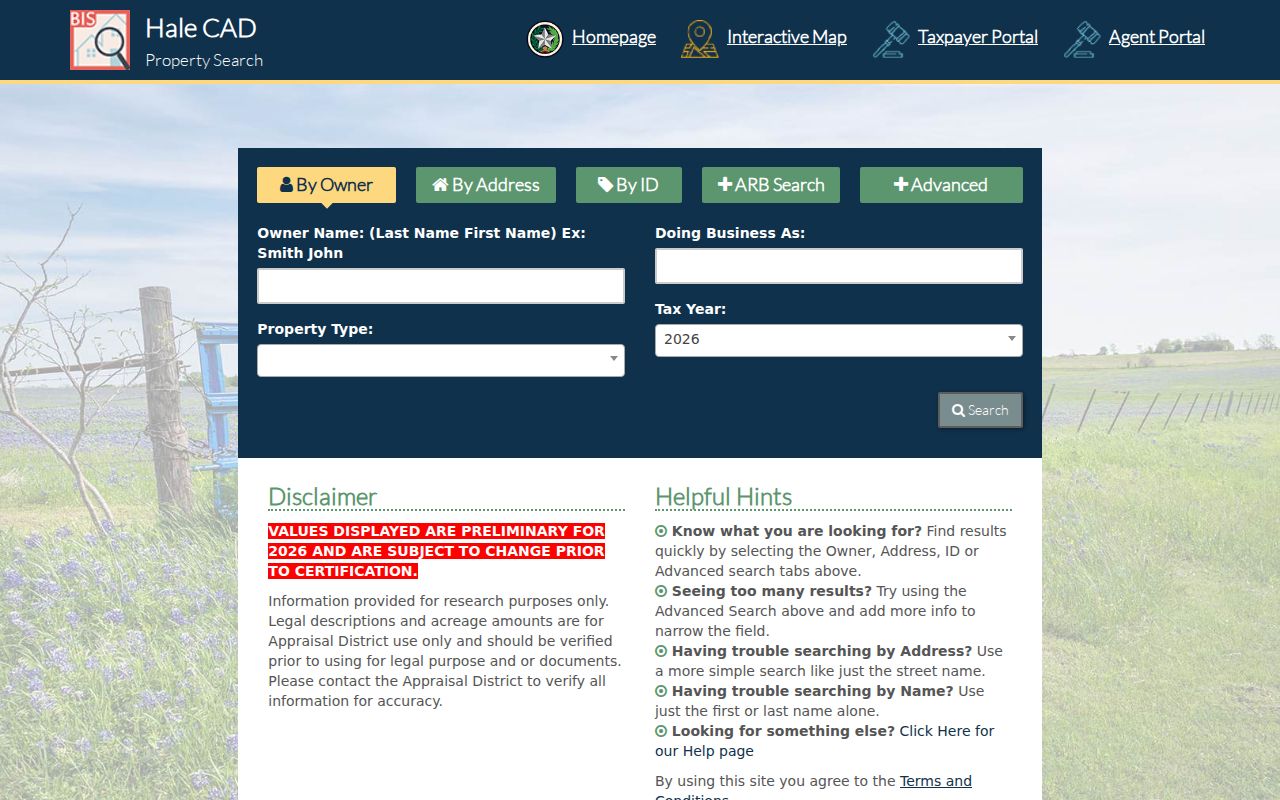
Moving between the CAD card and a dated library source helps separate a present parcel relationship from a past household record.